
"Trust the universe. It has a plan."
"Everything happens for a reason."
"Stay positive."
Sounds comforting, doesn't it? These statements are often found in spiritual communities, self-help books, and these days, especially on social media. Spirituality, for most people, not only provides a sense of meaning, hope, and resilience in moments of despair, but also aids in navigating uncertainty.
But what happens when spirituality is used as a way of avoiding or escaping reality rather than a genuine tool for healing?
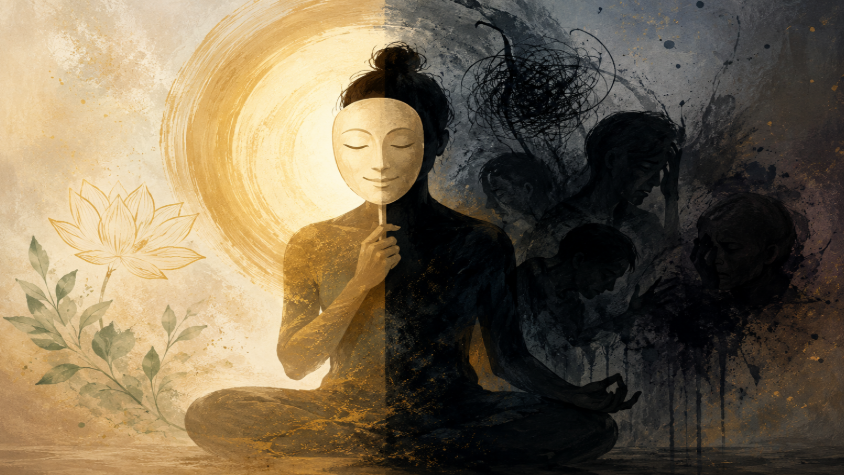
Imagine someone losing a loved one. The heart aches as the weight of the loss feels so heavy. At this instance, you tell yourself, "Everything happens for a reason". Or, consider getting furious at someone and calling it a "negative vibration". Overtly, these responses feel calm and spiritual. Covertly, however, the emotion remains unresolved. Psychologists refer to this phenomenon as spiritual bypassing —the tendency to use spiritual beliefs or practices to avoid dealing with difficult emotions, psychological wounds, and uncomfortable realities (Welwood, 1984). To simplify, it is like dismissing your emotions or wounds through spiritual statements rather than confronting them.
The appeal of spiritual bypassing is understandable. Emotional pain is uncomfortable. Grief hurts. Fear feels overwhelming. Anger can be frightening. It is a natural tendency of humans to reduce such discomfort. Then, why not use spiritual explanations when they provide immediate relief, certainty, and reassurance? Not to deny, spiritual bypassing, in most of the cases, is an attempt to protect ourselves, and to some extent these statements do provide comfort. However, one needs to understand that they are temporary in comforting, consoling, and convincing an individual. The difficulty, here, is that emotions do not disappear simply because they are ignored. They may become quieter for a while, but they often return in unexpected ways.
Unacknowledged grief can linger for years, and the weight of emotions remains unlifted. Avoided fears can show up as anxiety in the future. Suppressed or unprocessed anger may build up and later emerge through irritability or resentment. The concern here is in the fact that what one refuses to confront often continues to influence the individual from beneath the surface, where the sympathetic system never shuts, later having outcomes in some or the other form.
Consider emotions as messengers that communicate some signals of essential importance. Sadness may signal loss. Anger may indicate that a boundary has been crossed. Fear alerts to perceive threats. Thus, by silencing these messages using spiritual affirmations, they not only remain dismissed, but also remain unexpressed and unprocessed.
This by no means signifies that spirituality or spiritual practices are detrimental. In recent years, spirituality has become mainstream. Social media is promoting prayers, meditation, yoga, chanting, journaling, and many others to an extent that these spiritual practices have found a place in daily life. And undoubtedly, most of these practices are genuinely beneficial if done correctly. For instance, meditation helps improve emotional regulation, gratitude can enhance well-being, and spiritual beliefs can provide comfort during adversity. Increasing research emphasizes the importance of spiritual practices in mental health and healing, in instilling hope, optimism, resilience, well-being, self-growth, and happiness among individuals. Not only in mental health care but also in psychopathology, spirituality has also been associated with lower levels of depression, anxiety, substance abuse, and suicidal behaviour.
The problem arises not in being spiritual or engaging in spiritual practices, but in using it in a way that hinders rather than facilitates emotional growth. What happens here is that, rather than helping one have the strength to face adversities, it becomes a hiding place where one blindly convinces themselves that anger is unspiritual, sadness is a sign of weakness, or that anxiety can simply be manifested away. The question, then, emerges: should one not have a positive outlook? Undoubtedly, being positive or optimistic helps. It is indeed a sign of mental well-being. The extent of one's positivity towards things is what makes it detrimental, or what mental health practitioners call engaging in toxic positivity.
In spiritual bypassing, instead of processing our feelings, we try to rise above them. But it is of essential importance to know that rising above emotions doesn't equate to regulating emotions. This is what true healing means, not the absence of emotion, but being able to entirely experience them and being able to regulate them without becoming overwhelmed.
Perhaps the misconceptions come from the general notion shaped by social media in the picturization of healing that healing is peaceful. Is it always true, though? To be honest, healing is often messy. Healthy spirituality acknowledges what reality is. And reality is often ambiguous. Rather than denying the pain, it encourages individuals to face it with awareness and compassion by allowing the space for gratitude alongside grief, hope alongside sadness, courage alongside fear, forgiveness alongside anger, optimism alongside anxiety, and above all, faith alongside uncertainty.
The question here is not whether spirituality is helpful, but rather, whether one uses it to hide or to heal. When people stop pretending that painful emotions do not exist, that's when healing begins. Perhaps, then, the deeper question is - Isn't the most profound act of spirituality to acknowledge and process the pain instead of rising above it, isn't it building the strength to face the emotions? Is it?
Kanishka Mandaliya
