
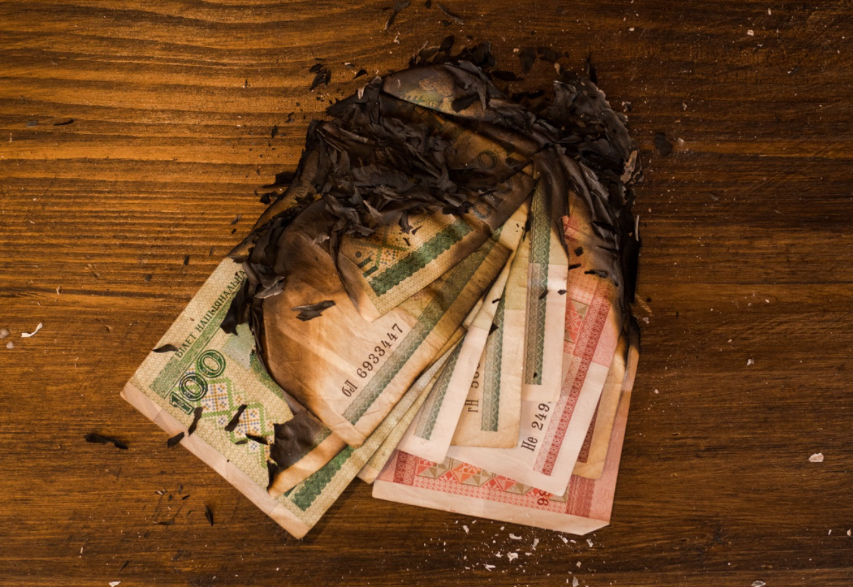
What if you bought a non-refundable flight ticket to destination X for $300? No matter the circumstances, you would feel obligated to follow through and catch that flight because you have already paid for it. Now your friends tell you that they are going on a road trip that same weekend, the road trip you would be more excited for. So you may hesitate. You do not want to waste the $300, but you don't want to miss out on a road trip with your friends either.
Now imagine: what if this was not a ticket, but a person who can sway you the moment they sense hesitation. Someone who was counting on you. It could be a relationship, a business deal, or a newfound opportunity, something that was of higher stakes than $300. Except this person knows how much you have already put in, so every time a doubt kicks in, they are ready with an explanation ready to convince you to stay.
That feeling you just had is called the sunk cost fallacy: the tendency to keep spending money, time, or effort on something because you have already done so in the past. Even though you know that the past cost is gone and you can only control the present, the reason this feeling is hard to shake is that we feel losses more than we feel equivalent gains, also known as loss aversion. For many people, losing $300 feels more painful than gaining $300 feels pleasurable.
Walking away from a bad deal, a bad relationship never feels neutral - it feels like you are choosing to lose or give up. However, staying even when every red flag is in front of you feels like keeping the door open. That possibility can make people willing to take additional risks in the hope of recovering what they have already lost. They delay the loss by risking more, hoping to undo it.
That is how scammers lure you in: they do not stumble into targets; they engineer them. Sometimes the bait is obvious, like badly written messages, obvious grammar issues, and strangely implausible stories. It may look like carelessness; people who recognise the warning signs may ignore the message, while those who respond become more promising targets.. Moreover, the “clumsy” email is not an accident; it tests the person. A paper published in 2024 supports the broader claim that scamming is an adaptive, interactive process in which scammers learn from their targets' responses and progressively tailor their manipulations to those individuals' vulnerabilities.
Once you are lured in, the sunk-cost engine goes on autopilot. A 2026 study of leaked scam training manuals found that operators are explicitly instructed to let targets "win" small amounts initially. By facilitating a modest profit and a successful withdrawal, they aim to avoid raising any doubts. This calculated reassurance is designed to build trust at a critical moment when many individuals might otherwise become suspicious and disengage.
This matches what psychologists have been seeing for decades: people not only resist walking away from a bad bet, they tend to double down hard right after something goes sideways. A decision-making study conducted in 1976 found that people committed the most resources to a failing course of action when they felt personally responsible for how badly it was going. The red flag does not necessarily make people stop. For many, it makes them push harder because stopping would mean admitting the red flag was real all along.
However, recent research suggests that the sunk cost fallacy might not tell the whole story. An experiment performed in 2022 simulated a scam and found no significant differences in responses between those who had already invested and those who had not. If the sunk cost truly mattered, one would expect stronger reactions from those with prior investments.
A 2026 study examining how people describe their own scam experiences found something messier: desperation, not miscalculation, often drives the decision to stay. People who needed a job, needed money, needed the relationship to be real- they were not failing at math. They were choosing the version of reality they could afford to believe in.
This distinction matters because it changes the blame game. Not everyone is equally susceptible, and the research suggests that certain psychological vulnerabilities may make some people more likely to fall into these patterns. A 2016 study found that people who get lured into the sunk cost fallacy also reported symptoms of depression and eating disorders - and due to having mental health problems notably, waited longer to seek help when they suspected a scam.
Taken together, all these studies point to an important learning: forget how much is already put in - knowing only what is true, would you choose this today, starting from zero? Asking this question can help you recognise when sunk costs are influencing your decisions.
This is not really about tickets, crypto, or strangers who claim to know you. It shows up anywhere a person has to choose between admitting a loss and chasing its reversal: a degree, a career, or a marriage. The amount was never really the point. What scammers understand, and what most of us do not want to admit, is that we were never protecting our money. We were protecting the story that spending it made sense.
It is crucial to recognize how vulnerable a person can be to these situations. Humans tend to believe that they are rational decision-makers, immune to others' manipulation, yet emotional investments can cloud our judgment. This vulnerability is not limited to any one demographic; it can affect anyone from seasoned investors to everyday consumers. Understanding the importance of making choices based on current realities rather than past commitments can empower us to step back and evaluate our decisions with a clearer mind, allowing us to break free from the grip of the sunk cost fallacy and make wiser choices moving forward.
Tanya Zaveri
