

In the Economic Survey 2020-21, it was highlighted that India's problem is not lack of regulation but over-regulation of standards and procedures which has ramifications over micro as well as macro dimensions of the Indian economy. The survey added that bureaucracy finds clarity in over-regulation due to simplification of rules and regulations but what it avoids is the actual supervision of the processes operating within the Indian economy. Supervision of the procedures and processes of the state of economy entails accountability while over-regulation on the other hand commands power and authority. This is further significantly highlighted in some of the indexes,
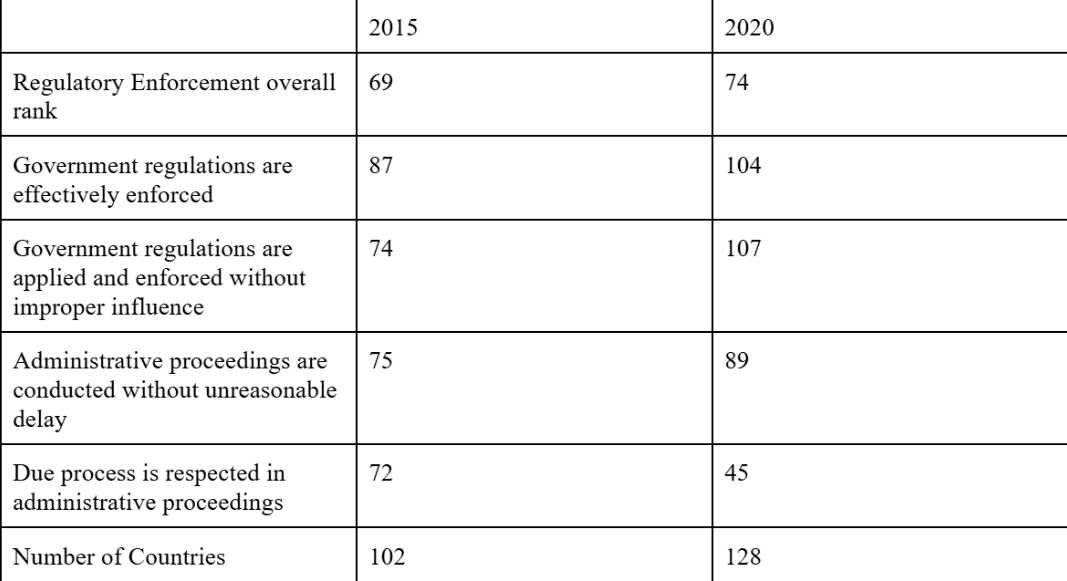
These indexes show that, contrary to the popular belief, India is relatively good at complying with processes, but lag in regulatory effectiveness.
Policy makers have come with both macro as well as micro solutions to solve the problems of over-regulation in the Indian economy as well as to increase the efficiency of the policies. Changing the methodology of calculating the GDP, the Goods and Services tax, the Insolvency and Bankruptcy Code, the Inflation Targeting Framework, PM Gati Shakti to enhance logistical infrastructure—all of these come under the umbrella of macro changes in the Indian economy. But what has been importantly sidelined from the literature of public policy and Indian economics is the role that process reforms have played in fixing and enhancing the performance of the Indian economy. The literature available until now has centered around Business Process Reengineering in the corporate sector although significant process reforms have been done in governments of all the world around.
The main goal of process reforms is to fix the nuts and bolts of the economy. It involves simplifying regulations and processes to improve the functioning of a scheme, policy, or any particular micro-dimension of the economy. For instance, rationalising the Legal Metrology Act 2009, which regulates manufacture and sale of measuring instruments and trade and commerce in goods which are sold by weight, measure or number. The over imposition of criminalisation of second offences under the Act has distorted the balance between empowering the legal metrology inspector and protection of legitimate entrepreneurs. These are targeted changes, small tweaks necessary for the success of giant and structural economic reforms. Despite process reforms being absolute essentials and fundamental to the functioning of the overall economy, the literature available on government applied process reforms is still under-developed. Members of PMEAC such as Sanjeev Sanyal and Aakanksha Arora have developed a methodology similar to Business Process Reengineering for process reforms in the Indian economy. The stages are–
Why is there a need for process reform?
Documentation of "as-is" process or Process Mapping
Process analysis to identify the exact issues
Reforms in the process
Monitoring of the new process
Using these steps, process reforms have been implemented in several government policies and legislations.
Some of the process reforms conducted in Indian public administration have been–
First, streamlining of the administrative processes applied in the Direct Benefit Transfer scheme - Earlier the money transfer used to happen through multiple intermediaries leading to duplication of beneficiaries, leakages and importantly leading to loss of 2 % of GDP and 50 % of total subsidy outlay. This led to DBT being launched involving triangulation of JAM- Jandhan bank account, Aadhar Number and Mobile number. The results have been encouraging. About Rs. 2.7 trillion have been saved till 2022. 42 million fake ration cards have been removed saving 1.35 trillion rupees. Additionally, one time identification of beneficiaries have been made possible. Moreover, during the pandemic DBT had been used to implement PM Gareeb Kalyan Yojna and it successfully provided food to 85 % of rural households and 69 % of urban households.
Second, changes in regulations of Information Technology (IT) and Business Process Outsourcing (BPO) sectors in India - over-regulation led to complicated compliance and increase in financial cost of companies. Realising the issues, the government came up with an easing set of regulations. Such as - Clear definition of OSP (Other Service Providers) defined only as voice based BPO service providers that led to clarification over BPO’s identity, Removal of registration requirement, Removal of distinction between domestic and international OSPs, Work from home and remote locations allowed, Interconnectivity and infrastructure sharing between OSPs allowed. Further, NASSCOM conducted a survey in 2021, and found that 92% have noted reduced compliance burden.
Third, adding capacity in some levels of the government - There was a dire need to increase the manpower in the Intellectual Property rights ecosystem as the number of years taken to process the patent application in India ranges from 5 -10 years while it is 2-3 years as per the global best practices. Manpower employed in the Indian patent office is only around 900, as compared to 13704 of China and 8132 of the U.S. Office of Controller General of patents and trademarks has already started increasing the recruitment.
Fourth, removing state mandated activities - As per the current status, pre-litigation mediation in India for commercial disputes as mandated under Section 12A of the Commercial Courts Act 2015 is compulsory. Research such as Manivannan (2023) and Sanyal and Mishra (2023) found out that in 99% of cases that pre litigation meditation has not worked out. Taking the feedback from the parliamentary committees as well as academic research, the Mediation Act 2023 was passed, doing away with the compulsion of pre litigation meditation and making it voluntary.
Additionally, process reforms can be further applied by rationalising both government bodies and legislations which will include reducing the unwanted departments, autonomous bodies both constitutional and statutory and further eliminating archaic legislations from the colonial era, the government can bring laws and regulations in sync with evolving Indian society and state. For instance, the government can rationalise the bodies such as Agricultural Produce Market Committee and review Essential Commodities Act, 1955 in order to modernise and integrate farm markets leading to One Market, One Law. These reforms will encourage farmers to do direct and electronic trade anywhere in India. The results of this process, if carried out in the domain of agriculture and markets, will reduce the monopoly of mandis, disempower the corrupt middlemen, etc. This will lead to better price discovery by farmers, lesser regulatory burden and enhance consumer satisfaction. Process Reforms in Essential Commodities Act, 1955 shall lead to deregulation of storage facilities in order to encourage private infrastructure for agricultural produce. But these reforms have to be accompanied with other initiatives such as digital literacy programs in order to prevent the top down approach to policy making. These small tweaks in public administration of India have a far reaching impact on the public experiences of procedures gradually leading to ease of doing business
This article is an attempt to showcase that process reforms are a significant part of public policy and economics. The literature upon which should be further systematised and become part of wider academia. The government through various methodologies have been training government employees and have also created a process reforms policy toolkit in order to make process reforms mainstream in public policy. In the domain of public administration, significant attention has to be given to the iterative changes that enhance economic efficiency without always needing giant structural changes.
Shreya Shinde
