
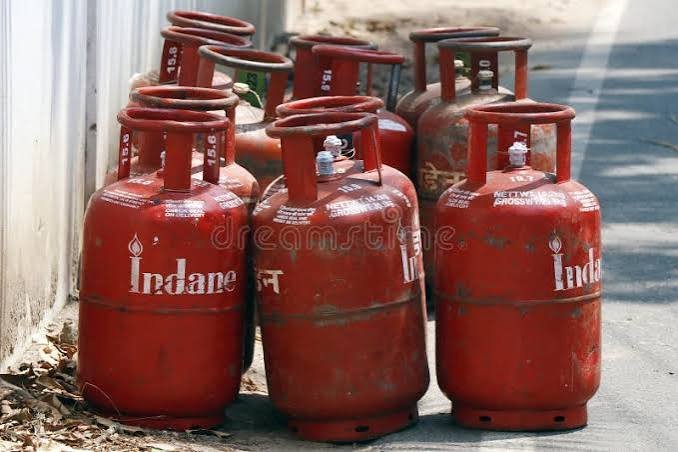
The West Asia conflict involving the United States of America, Israel, Iran, and other countries has teetered on for more than 2 months. Although conflicts have far-reaching economic impacts, the recent conflict has severely impacted global trade through key trade channels, such as the Strait of Hormuz, which passes over one-sixth of global oil production and one-third of the world’s liquified natural gas (LNG). In particular, this has crippled merchandise and goods trade related to liquefied petroleum gas (LPG). Economic estimates suggest that every US$10 increase in global oil prices could reduce India’s GDP growth by approximately 0.1–0.2 percentage points and increase inflation by around 0.2 percentage points.
In this article, we examine India’s dependency on LPG and how it varies across states to understand the impact of the blockade on the Strait of Hormuz. India is particularly vulnerable to such shocks because it is heavily dependent on imports for LPG consumption. In 2025, India consumed 33.15 million tons of LPG, mostly used as cooking gas, with imports accounting for about 60% of demand. About 90% of those imports came from the Middle East. India’s total LPG connections grew from 14.52 crore in 2014 to 32.83 crore by late 2024. In response to the crisis, government efforts have been aimed at improving domestic production, which rose by 25-38%. With the dependence on LPG seeing a 6-fold increase since the late 90s and over 33.37 crore LPG customers, this is no longer an inconvenience but a crisis.
To understand just how large the crisis might be, it is worth considering what the Government of India’s policy has focused on in recent years. India has made major progress in expanding access to clean cooking fuel using the Pradhan Mantri Ujjwala Yojana (PMUY) since 2016. Under the scheme, free LPG connections were provided to women from poor families, particularly in rural areas, drastically increasing access. Despite these policy efforts, India’s LPG supply still heavily depends on global supply chains since access does not translate into sustained use.
The most important factor may be affordability. Even though the government provided them with a subsidy of Rs. 300 per cylinder for up to 9 refills per year, the overhead cost of Rs. 613 per cylinder is still considered to be expensive for the poor households. Under the PMUY scheme, poor Indian households average only about 3.95 to 4.34 refills (cylinders) per year. A large number of households in rural India stack fuels, meaning they will continue using firewood or dung as cooking fuel, irrespective of holding a LPG connection. This gets worse when they are hit with an energy crisis, like the ongoing one, where the prices increase sharply, and the refill wait is also huge. This gives them no other option but to switch back to the wood-fired stoves. This is only scratching the surface, as it does not take into account the dependence of informal street vendors and other small firms on LPG fuel.
This can be clearly seen below in Figure 1, which shows LPG usage as primary cooking fuel by state (rural vs urban). Out of all the households in the states at the bottom in Figure 1, Rajasthan, Gujarat, Odisha and Punjab, less than 20% of rural households use LPG as their main cooking fuel. This clearly means that even though these households are eligible to receive a LPG connection under PMUY, they do not fully rely on LPG as the primary source of cooking fuel. These states also show that the urban-rural divide is very wide since they show a difference of more than 60 percent (Figure 2). The lack of reliance on state-sponsored schemes such as PMUY suggests that rural households in these states, especially, may be more vulnerable to supply-side shocks to LPG, and may even shift to traditional fuels in response to shocks. States at the top of Figure 1 (such as Bihar, West Bengal and Assam) show that a high proportion of rural households use LPG. But these numbers need to be read with caution since there are chances of fuel stacking and low refill rates.
Thus, for most states at the top of Figure 2, urban households are more likely to bear the brunt of supply-side shocks. Policies such as PMUY, which are aimed at rural households, may not be sufficient to help smooth fuel consumption among these households.
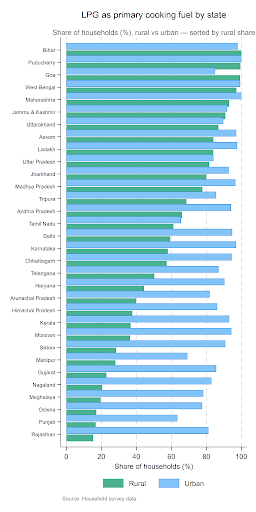
Figure 1
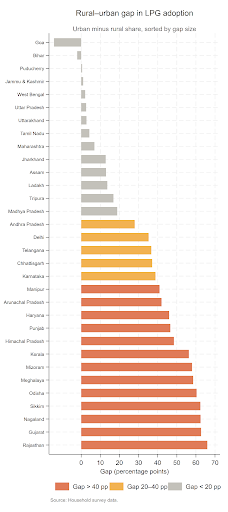
Figure 2
Additionally, from Figure 3, we can deduce that not every household is affected by an LPG shock in the same way. States in which a household depends heavily on LPG (plotted on the vertical axis) but at the same time relies on LPG subsidies (plotted on the horizontal axis) are highly vulnerable. These are on the top right of the graph (including especially the Union Territories and rural Maharashtra). Even a small increase in the price will force the family to switch to traditional fuels, and they will continue to face the ill effects of the problems associated with them. In contrast, a higher-income household may not be adversely affected by the price shocks.
We also see that states in the bottom right, like Arunachal Pradesh, Nagaland and Himachal Pradesh, receive subsidies, but they are not regularly using LPG, suggesting that affordability, refill costs, supply reliability and household habits continue to matter. However, states in the top-left like Goa, urban Tamil Nadu and urban Telangana show relatively high LPG usage even though they do not receive higher subsidies. This could be due to income levels as well as better market access to LPG. Rural Odisha, rural Rajasthan and rural Punjab, found in the bottom-left of the graph, show that the transition is still emerging. Therefore, providing households with LPG connections is one thing, but the sustained use heavily depends on whether families can afford it, even more so during the present crisis.
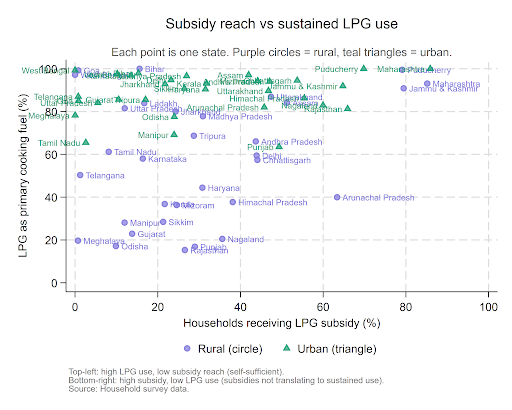
Figure 3
This analysis has only looked at broad variations in LPG dependence across India. Looking more specifically at unevenness in dependencies (such as low-income or poor households) may reveal vulnerabilities that are likely already playing out in India. There may be impacts in other sectors, such as the restaurant industry, which can be understood through looking at the impacts on firms that use LPG.
The government has, for its part, been proactively attempting to mitigate these impacts. This involved a combination of easing bottlenecks in household purchase of cylinders, increasing domestic production capacity, and diversifying LPG imports (such as Argentina), although at much higher costs.
If anything, the crisis has exposed the underlying vulnerabilities in the energy security and resilience ofIndian households. To make the energy policy more successful, India needs to focus on resilience along with access. It can begin by diversifying import sources (e.g., long-term partnerships with countries like the United States, Australia, and Argentina). Additionally, building strategic LPG reserves and allowing for flexibility in the provision of subsidies in times of distress, so that low-income households do not go back to using the traditional fuels. In order to preserve the progress, India needs to focus on resiliency and move beyond just access.
Anirudh Tagat and Netra Damani
