
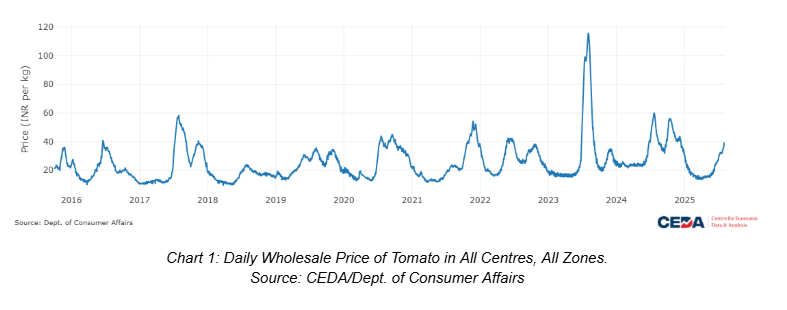
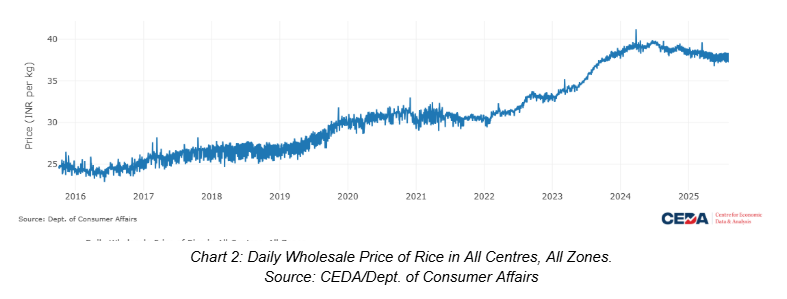
As you walk through the busy Indian mandi market, you purchase tomatoes for Rs 30 a kilogram. A few days later, you find that the price of tomatoes has skyrocketed to Rs 199 per kilogram. At the same time, you find that the prices of rice remain relatively stable. Let's examine Charts 1 and 2 below, which illustrate the price fluctuations in tomatoes and rice, respectively, over the past decade. We observe that the price of tomatoes shows short-term frequent fluctuations, whereas rice prices are moving gradually with significantly less volatility.
Two everyday staples, yet so different? In our everyday life, we see that some crops like rice, wheat, sugarcane remain less prone to extreme short-term fluctuations, whereas tomatoes, potatoes, and onions are highly volatile. The journey of every crop, from farm to market to kitchen, is shaped by many factors: the agro-climatic zone, the soil conditions, the storage capacity, transportation networks, and the demand-supply dynamics.
In economics, slow adjustment of prices is called price-stickiness. Understanding why some crops exhibit price-stickness while others are volatile or price-responsive requires looking at various factors from agro-climatic zones, and production risk to storage, transport, markets, and government procurement policies. Let’s look at how each of these factors shapes price behaviour.
Agro-climatic zones influence price responsiveness and the supply of agricultural produce. India has a wide variety of agro-climatic zones. Each zone is suited for different crops and farming practices. Tomatoes, for example, grow well in warm regions but suffer from intense heat or rain. As a result, the supply of tomatoes from coastal routes decreases more quickly during the monsoon. On the other hand, states like West Bengal, Odisha, and Kerala are suitable for growing rice, promoting consistent production, and reducing the price swings.
Simply put, the same climatic shock creates different price dynamics because of the differences in climatic zones. The drought in Maharashtra and the drought in Karnataka are not the same. For instance, the Marathwada region is highly dependent on groundwater, which quickly runs out during dry spells. As a result, the output of tomatoes declines sharply. Meanwhile, districts in northern Karnataka, such as Belagavi and Dharwad, have access to canal systems from the Krishna and Tungabhadra rivers. Hence, even during moderate drought years, farmers can maintain a baseline vegetable production, having a softer impact on prices.
Another reason for the differences in price stability is production risk. Farmers in arid zones often face unpredictable rainfall and high temperatures. If there is erratic rain or a pest attack, the supply decreases, resulting in higher prices. Even after the supply is balanced, the prices do not drop immediately. Prices of tomatoes in Kolar APMC spike regularly due to short-term weather shocks and fall slowly because traders ‘anchor’ to previous high-price periods. This anchoring behaviour leads to price stickiness.
In contrast, rice farmers in irrigated zones have reliable access to water, which helps maintain steady agricultural production, reducing the severity of climatic ups and downs. When demand grows, the supply is buffered, and when demand falls, the price adjusts neatly and avoids dramatic swings.
Geography and climate have an impact on transportation conditions, which in turn affect agricultural prices from the field to the market. The cost of transporting tomatoes over mountainous terrain, winding roads, and erratic weather raises the price of the produce, adding to its stickiness. In hilly states like Himachal Pradesh, during the monsoon, supply is disrupted, leading to a spike in rates due to landslides and road closures. In contrast, rice cultivated on the large, flat, and irrigated areas benefits from an efficient transportation network. Moreover, rice can be stored for longer periods, which helps traders stock the crop strategically, dampening price volatility.
Institutional differences and market power also influence price changes. Farmers in some agro-climatic zones have access to large wholesale markets, processing units, or cooperative systems. In other instances, middlemen often try to control the distribution channel. Farmers, especially from semi-arid and rain-fed areas, might depend on local intermediaries who influence price by controlling the access to storage facilities or by delaying purchases during harvest peaks. The FAO claims that middlemen typically earn 20 times more than farmers do, which results in disproportionately huge profit margins at the farmer's expense.
Lastly, seasonality and government interventions also play an important role. Tomatoes are a seasonal crop. A poor harvest can create a nationwide surge in its price. Rice, on the other hand, is cultivated in both kharif and rabi seasons. In addition, rice is protected by the minimum support price (MSP) and public procurement systems, which make it less vulnerable to short-term shocks. Punjab maintains steady prices of rice because government procurement covers more than 90% coverage for the crop, offering farmers a consistent and assured market. In contrast, Jharkhand, where agriculture depends on rainfall and procurement is minimal, has more pronounced price fluctuations.
When you look back at the two charts again, you see the stories told by the different landscapes of the country. The heat of Rajasthan, the floodplains of Assam, and the coastal belts of Tamil Nadu each have a fingerprint of how tomatoes and rice behave in the market. Price rigidity or volatility is not just about markets, but climate, geography, human decisions, and the occasional tantrum from nature, woven together.
Ishita Narvekar
