
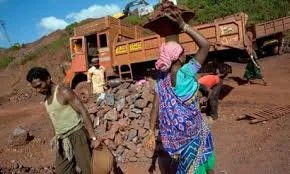
India has rich mineral states like Jharkhand, Odisha, and Chhattisgarh. Mining is not just an industry here, but it is life for many, especially among marginalised communities. The maximum portion of this workforce is informal, which includes daily-wage labourers, contract workers, and migrants who come for seasonal work. A recent scoping review highlights that silicosis and other dust-exposed occupational diseases are concentrated in such informal, poorly regulated sectors.
These exploitative conditions are not isolated; they are part of a broader environmental injustice. Environmental historian Ramachandra Guha described how the poor bear the heaviest costs of ecological destruction. While cities consume the electricity and steel, it is the marginalised who breathe the dust, lose their livelihoods, and inherit degraded lands. Guha’s idea of the ‘environmentalism of the poor’ reminds us that environmental destruction affects communities disproportionately. It is the marginalised who live close to the dust, poisoned streams, and barren fields. Communities in mineral-rich states disproportionately shoulder environmental and health costs because of poverty and weak regulation. As a result, their basic rights, such as the right to health, livelihood, and dignity, are being impacted.
Mining also creates displacement, uprooting villages for coal blocks or quarries. It shrinks the other forms of livelihood, such as agriculture and forest-based occupations, by forcing many to depend on mining wages for survival. In Odisha and Chhattisgarh, indigenous families have been pushed off ancestral land, which cuts off their ties with the forests, farming, and spiritual practices. This loss is not just economic; it is a cultural estrangement, leaving communities alienated from their traditional identities. Therefore, displacement is not just the loss of land but the erosion of belonging and continuity. In Rajasthan’s sandstone/quarrying belts, many families are displaced and depend fully on mining wages. Compensation and rehabilitation policies are often weak or delayed.
Many quarries lack proper ventilation, dust suppression, protective equipment, or regular inspections, especially in remote or illegal sites. Illegal mining contributes heavily to accidents and unsafe working conditions. In Dhanbad, Jharkhand, illegal coal mines have caused multiple deaths. Toxic gas exposure is higher, especially in illegal or poorly ventilated mines. In Surendranagar district, Gujarat, three workers without helmets or masks died inside an illegal coal mine after inhaling toxic gas. Many small illegal quarries of this kind operate across India, exposing miners to extreme risks.
Rat-hole mining tragedies are so common in the North-East, where high wages attract impoverished workers despite the dangers. Child labour complicates this issue further. In Rajasthan’s sandstone industry, children as young as eight years work in grinding and chiseling stones, which means they are unprotected, underpaid, and exposed to silica dust from a very young age. Recently, in January 2025, nine workers were trapped and drowned in a flooded rat-hole coal mine in Assam, when water gushed in from adjacent abandoned tunnels.
A systematic review on occupational health and safety calls for proactive safety interventions, miner education, and stricter enforcement. Technology could actually help; IoT-enabled helmets are being tested to detect collapses and toxic gases. But without political will, funding, and accountability, such solutions remain unimplemented. Beyond the mines, the toll of mining seeps into homes and communities, where illness and loss reshape everyday life. Who looks after the families when miners fall ill? The consequences of illness ripple across households. The informal nature of their work does not bestow them with social protection. At the centre of this crisis lies a slow and silent killer, Silicosis. Silicosis is a lung disease caused by inhaling silica dust. A 2025 article describes Silicosis as a “public health emergency” long ignored because it affects the poorest. In a recent study conducted by researchers from the ICMR‑Regional Medical Research Centre, Bhubaneswar, among the mining workers in Odisha, multimorbidity was common, which reflects toxic exposure and poor healthcare access. In Jharkhand’s iron-ore belts, a health survey conducted by researchers from the National Institute of Miners' Health (Nagpur), found 3.4% cases of pneumoconiosis, high rates of noise-induced hearing loss, and undernutrition among workers and surrounding populations.
In response to growing evidence and advocacy, some state governments and civil society groups have begun to act. In Jharkhand, a coalition of civil society organisations launched the SAARTHI Just Transition Network (2025) to support miners and mining-affected communities. In Chhattisgarh, environmental activist Alok Shukla has fought coal mining in forest zones and won the Goldman Environmental Prize (2024). The Supreme Court of India (2024) declared silicosis prevention as a human rights duty; it also mandates compensation and preventive measures.
Many NGOs, such as GAGGA Alliance, Samarpan, and IAOH, run awareness drives, provide legal support, and advocacy to miners and mining-affected communities. But resource constraints limit the scale of reach, and many remain unreachable. What is the use of all these legal provisions, when there is a problem with the enforcement? Is there accountability or regular inspection on the ground?
Though labour powers the country’s growth, miners remain trapped in a cycle of dust, disease, and danger. Breaking this vicious cycle needs an urgent shift in priorities. Health, dignity, and rights must be placed above profit. Strict inspections, access to healthcare, and enforcement of safety standards are essential, not optional. Unless these changes are made, mining will continue to cost the lives and livelihoods of the marginalised workers.
Gorla Sravani
