
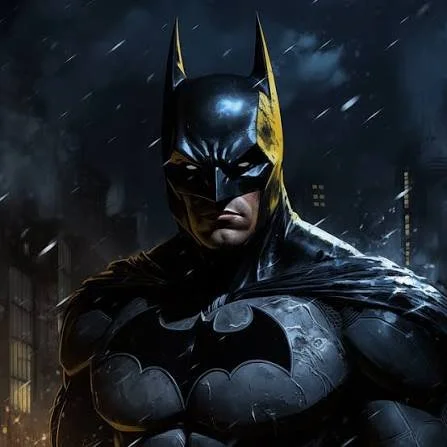
Since his debut in Detective Comics #27 (1939), Batman has evolved from a pulp-style vigilante into one of the most recognisable characters in popular culture. Yet, it would be misleading to think of Batman as a single, fixed character who has simply been moved from one medium to another.
Batman has existed in comics, films, television, animation, video games, toys, and children's media. Each of these forms tells stories differently. They offer different ways of perceiving, experiencing and engaging with a character. As a result, each medium has played a role in shaping the Batman we know today.
In this sense, Batman is a transmedia character, whose identity has been built and rebuilt across different media. His evolution is therefore not just a history of different writers and actors. It is also a history of what different media allow Batman to become.
Comics are where Batman began, and the medium gave the character some of his most recognisable qualities. The comic page can communicate through a combination of images, dialogue, narration, panel layout, colour and visual symbolism. From his earliest appearances, Batman was often presented through shadows, dramatic compositions and exaggerated imagery. These visual choices helped establish him as a mysterious and intimidating figure. Comics also have a unique relationship with time. Batman can appear in stories published decades apart while remaining essentially the same age. This allows different versions of the character to exist across different periods without necessarily replacing one another. This allows audiences to accept very different versions of Batman. A dark, serious Batman can exist alongside a lighter or more humorous version without either one completely cancelling out the other. Comics make this particularly easy because different writers and artists can create their own interpretations of the same character.
When Batman moved into live-action film, the character gained something that comics could not provide in quite the same way: a human performance. An actor's face, voice, body language and physical presence become part of the character. Cinematography, music, sound and production design also influence how Batman is understood. Christopher Nolan's The Dark Knight trilogy i.e. Batman Begins (2005), The Dark Knight (2008), and The Dark Knight Rises (2012) presents Batman through a grounded and realistic world. Matt Reeves' The Batman (2022) similarly places greater emphasis on Batman as a detective and on his psychological state. Film also tends to give stories a stronger sense of progression. A filmmaker can take Batman through a clear emotional or psychological journey within a single film or trilogy. The medium therefore allows Batman to be reinterpreted through performance, atmosphere and character development. For example, Reeves' Batman begins with the idea of vengeance and gradually moves toward a different understanding of what his symbol can represent. The medium of film, with its emphasis on performance, atmosphere and character arcs, gives this transformation considerable weight.
But film can also inherit a version of Batman that was developed in another medium. Frank Miller's The Dark Knight Returns (1986), for example, presented an older, more physically imposing and darker Batman, and its Batman-Superman confrontation became particularly influential. Decades later, Zack Snyder's Batman v Superman: Dawn of Justice (2016) carried several of these ideas into live-action. Affleck's Batman has a similarly heavy, armoured appearance, and the film's Batman-Superman confrontation deliberately echoes Miller's work. In this case, a version of Batman first developed in comics is carried into live-action, where elements of Miller's interpretation are reworked within a new cinematic context.
Animation opened up another set of possibilities. Unlike live-action film, animation does not have to follow the physical limits of the real world. Characters, environments, movement and visual styles can all be exaggerated. Batman: The Animated Series (1992–1995) is an important example. Its visual style combined elements of earlier Batman comics with the gothic atmosphere associated with Tim Burton's films. It created a Batman who could be dark and serious while still being accessible to a television audience. Animation also made it easier for Batman to move between different tones. The same basic character could exist in serious stories, children's programming and comedy without losing his recognisable identity. The LEGO Batman Movie (2017) takes this even further. It uses humour and exaggeration to turn a traditionally serious character into someone who can be silly, vulnerable and self-aware. The interesting point is that these versions do not necessarily stop being Batman simply because they are very different from the darker versions audiences may be familiar with.
Video games change the relationship between character and audience even more dramatically. When watching a Batman film, the audience observes Batman. In a game such as the Batman: Arkham series (2009–2015), the player controls him. This changes how his abilities are represented. Batman's combat skills, detective abilities, gadgets, movement and exploration are no longer simply things we watch him perform. They become things the player actively performs. This is one of the most important contributions of games to Batman's evolution. The Arkham series effectively turn Batman's abilities into an experience. The player learns how Batman moves, fights, investigates and solves problems. In this sense, the medium doesn't simply provide a new story about Batman. It provides a new way of experiencing Batman. Batman’s evolution therefore cannot be understood simply as a straight line from comics to film to games.
Instead, there is a kind of feedback loop:
Batman → enters a new medium → the medium changes how he is represented → audiences develop new expectations of Batman → later creators reinterpret him again.
Frank Miller's The Dark Knight Returns (1986) provides a useful example. Miller presented an older, darker and more politically charged Batman. That interpretation contributed to the broader shift toward a darker version of the character and influenced later portrayals.
The Batman: Gotham Knight (2008) animated anthology provides another interesting example of this process. Released in 2008 alongside Christopher Nolan's The Dark Knight era, it carried elements of that cinematic interpretation into animation. It was not simply a “fourth Nolan film”; instead, it demonstrates how a version of Batman established through live-action cinema could be extended and reinterpreted through another medium. The change in medium allowed the creators to explore Batman in ways different from the live-action films while still drawing from the identity established by them.
This is important because a version of Batman created for one medium can eventually influence how Batman is represented in another. A characteristic that may become prominent in comics can later appear in film. A cinematic interpretation can influence animation or games. A game can make certain aspects of Batman particularly memorable to a new generation of audiences.
Over time, these different versions begin to feed into one another. This brings us to the central problem. If Batman can be serious, funny, realistic, exaggerated, violent, vulnerable, animated or interactive, what allows audiences to recognise all of these versions as the same character?
According to Enrico Terrone’s (2017) “On Fictional Characters as Types”, this structural tension can be addressed by distinguishing between a type, understood as the abstract fictional character, and its tokens, understood as the particular fictional individuals specified by that character across different fictional worlds.
A type is the general idea of something, while a token is an individual example of it. In the case of Batman, the general idea of Batman is the type, while while Bale's (2005–2012), Affleck's (2016–2023), Pattinson's (2022), LEGO Batman's (2017) or the Arkham version (2009–2015) can be understood as different tokens of that broader character.
The individual versions can change considerably while retaining enough recognisable elements to remain connected to the larger idea of Batman.
These elements may include his origin, his identity as Bruce Wayne, his use of the bat symbol, his lack of conventional superpowers, his relationship with crime and justice, and his reliance on intelligence, training and technology. The exact combination can change. The emphasis can change. But there appears to be a point beyond which a portrayal would no longer be recognisable as Batman. Batman therefore offers a useful case study for a much larger question about popular culture:
The character influences how creators use a medium, but the medium also influences what creators can do with the character. Comics, films, animation and games each bring different possibilities, and each has contributed something to the evolving idea of Batman.
This may be one reason Batman has remained relevant for so long. He does not survive different media by remaining completely unchanged. He survives because he can change with the medium while retaining enough of his identity to remain recognisably Batman.
The Dark Knight, in other words, has never simply travelled across media. The media have helped create who the Dark Knight becomes.
Sarang Kulkarni
