
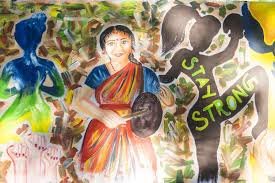
Before we speak of womanhood, it is worth pausing at the idea of the “perfect,” and the long-lasting image of the “perfect woman” that shapes how womanhood itself is imagined. This tension is particularly apparent in the lives of women in India's cities and small towns. Even though women now have access to legal rights, work opportunities, and education, many still struggle to balance their true selves with the expectations placed upon them. At the centre of this conflict is the figure of the “perfect woman,” prominent in the middle class who is expected to professionally successful, emotionally available, domestically efficient, and culturally compliant all at once, without evident strain. This ideal deeply operates as an unspoken set of norms that shape how individuals think, behave and evaluate themselves and others. It builds a kind of pressure, leaving them feeling anxious, unsure who they really are, and disconnected from themselves. Beyond surface-level social imbalances, these gendered rules deeply impact the psyche, heavily influencing a woman's capacity to live authentically.
Modern societies often place faith in individual transformation through education, financial independence, mental health awareness, and personal development. However, this framing risks shifting structural problems onto individuals. It assumes that better choices or will resolve deeply embedded inequalities. In doing so, it obscures the fact that the surrounding social conditions remain largely unchanged. For example, women may be encouraged to pursue education and careers, while being expected to prioritize marriage and family life. This conflict carries into their everyday life; even as women enter the workforce in greater numbers, they continue to carry a disproportionate share of unpaid domestic responsibilities. It reflects how postfeminism and neoliberal feminism celebrate women's ambitions in rhetoric but rarely in practice, much like the sentiment behind “Beti Bachao, Beti Padhao,” where empowerment is promoted without addressing the conditions for real equality. As a result, empowerment becomes performative rather than substantive, and responsibility for failure is subtly returned to the individual.
These structural contradictions take a psychological toll, placing them in a space where no choice feels right since what they want, what they feel, and what they are permitted to express no longer align. I’ve seen some women give up independence to keep the peace, while others navigate a stream of mixed signals that constantly pull them in opposite directions. They are told to be independent but not so much that it takes them too far away from their family, build a career but never let it come before home, speak up but stay agreeable. This is what Gregory Bateson described as a “double bind,” where women simultaneously receive contradictory messages and must constantly navigate between them, leading them to question their own decisions, suppress their desires, and modify their behavior to conform to expectations. Many women express feelings of anxiety, exhaustion, guilt, or simply inadequacy. In this sense, psychological distress extends beyond the individual factors and emerges from the contradictions embedded within social structures.
As women constantly adjust themselves to fit in expectations, what happens to how they begin to feel about themselves as this continues?
Over time, these repeated adjustments settle into internal schemas that shape how women see themselves and regulate their actions. In India, the expectation that marriage should take priority over career often acts as an anchor in shaping life decisions. So many highly skilled women continue to navigate between adherence to a socially accepted timeline for marriage, managing negotiation between work and family, and have stepped out of a full-time career to a part-time role to accommodate these expectations. This continuous expectation to align with family expectations and marriage timelines can slowly push women to make choices that reshape their career path, often without realizing it, due to dual role conflict, a situation where the demands of two roles such as professional responsibilities and family expectations clash and create ongoing pressure to meet both. In the long run, these patterns of thinking start to define how women view themselves, how they understand their roles, their worth, and what they believe is realistically available to them. In this sense, the idea of self emerges from lived experiences of the psyche shaped by ongoing sociocultural norms and gendered expectations, but do these influences remain limited to family and marriage, or do they extend further beyond it?
Although more women in urban India are now accessing higher education, this still does not translate into equivalent participation in the labor market, and in many cases, it fails to ensure employment and meaningful economic empowerment. This gap exists because the labor market continues to privilege male-dominant, secure, white-collar employment or meaningful economic empowerment, which limits access to stable and rewarding career opportunities. This reflects a pattern of systematic constraints, one that limits movements, narrows possibilities, and reinforces inequalities. As Anthony Giddens notes, structure is both the medium and outcome of social practices; therefore, individual effort alone cannot dismantle the institutional constraints that limit identity. Does this mean that no matter how much a woman strives, nothing truly changes unless the surrounding conditions also change?
With this understanding, freedom becomes less about the formal access to legal rights and more about the realistic capacity to act on it in everyday life. In such a context, freedom becomes what Simone De Beauvoir describes as situated freedom, appearing almost as a form of “frivolous freedom” present in discourse yet constrained in practices, where choices seem free but are shaped by the limited conditions. Then, what is the self without the lived freedom, and what is this freedom really in relation to the self? I often wonder if my choices are really mine, or just shaped by the options made available to me and what I might have chosen if those limits weren’t there.
Vaishnavi Sapkale
