
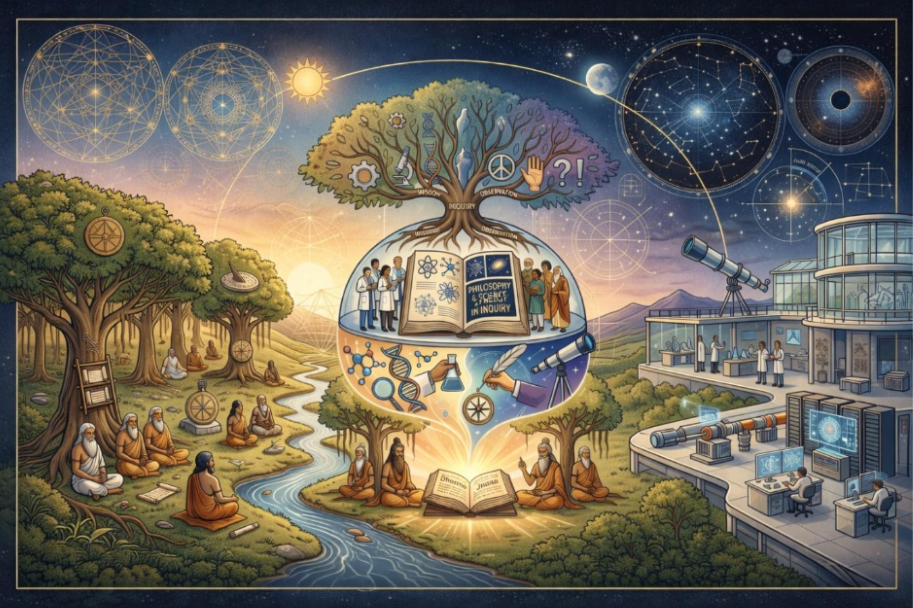
Philosophy is rarely taken seriously in scientific circles. It is often dismissed as abstract, impractical, and untestable. But our ancestors—the founders of science—took a significantly different approach to philosophy. Philosophers like Aristotle, Plato, and Socrates have engaged deeply with questions concerning nature, human consciousness, and have moved beyond abstract theories to question the cause and existence of things and understand the ultimate purpose of life. Human desire to understand the world is far older than formal scientific disciplines. Human curiosity to know nature led to the formation of natural philosophy.
Natural Philosophy: The Zygote of Modern Science
Modern Science is often viewed as something which originates in laboratories, driven by observation, experimentation and empirical findings. Scientific disciplines—physics, chemistry, biology, etc—have emerged from innate human curiosity, however, prior to the existence of these disciplines, there was natural philosophy.
Natural philosophy was the systematic, logically-based study of nature and the physical universe, while discarding mythological and supernatural arguments. Until the 19th century, natural philosophy was a branch of philosophy within which the disciplines of modern science topics were explored. Philosophy at the core level is the study of fundamental questions that arise in everyday life and in the practice of other disciplines. Some of these questions question the nature of reality, while some question the extent of human knowledge. Thinkers like Aristotle, Plato and Socrates asked foundational questions about the existence and nature, however, it was the later philosophers like René Descartes and John Locke who had reshaped these questions such that they aligned with modern science. Descartes had argued that natural phenomena could be explained through matter in motion which is directed by certain laws. The shift of preference in explaining the existence through a systematic view based on evidence, logical deduction and empirical findings over a holistic view lead to the development of modern scientific thinking.
The Transition of Philosophy to Science
Until the 19th century, today’s “Science” came under the domain of natural philosophy. The shift from philosophy to modern science was not due to the change of questions, rather, it was due to the development and change in methodology and approach. In sharp contrast to philosophy, science focuses on empirical findings, what is observed, measured, and verified. However, in certain cases, the scientific investigation begins when philosophical concepts become testable.
The birth of psychology is an example of the transition of philosophy becoming testable, leading to the emergence of a branch of modern science from a philosophical concept. Today, psychology finds its nutrients from neuroscience and behavioural science; however, before it emerged as a distinct experimental discipline, psychology was rooted in the philosophical questions—How do humans think and interpret? What is mind? What is consciousness? These questions were argued upon for centuries until they got directed by experimental approaches. In the 19th century, Wilhelm Maximilian Wundt, a German physiologist, philosopher, and professor, regarded as the ‘father of psychology’ had transformed the philosophical inquiries into experimental research and established the first laboratory dedicated to psychology. Wilhelm Wundt had notable works in the domain of psychology; however, in his text Ethics, he explored questions relating to human morals, concerning the areas deeply rooted in philosophy. His work didn't displace philosophy; it gave philosophical questions a methodology rigorous enough to test them. A similar example of philosophy acting as the groundwork, while science quantifying the ideas under testable circumstances can be observed in the work of an Indian mathematician and astronomer, Bhaskaracharya II in Siddhanta Shiromani, where he illustrated the tendency of objects to move towards Earth. Centuries later, Isaac Newton had formulated the universal law of gravitation within a standard, calculated framework. Despite the two works referring to the same thing, the works of Bhaskaracharya II were qualitative in nature; however, Isaac Newton had given it a quantitative structure abiding to the principles of modern science, which prioritizes empirical findings.
The difference was not in the curiosity or question, the difference lied in the approach. While philosophy gave an insight, scientific methodology quantified and justified it.
The Fragile Nature of Knowledge
It is important to understand the importance of preserving knowledge. Today, the internet is widely accessible, yet most users remain unaware of the mechanism enabling it. Similar to how a user of cloud computing may rely on the system they do not fully comprehend, modern society benefits from the scientific knowledge without studying the foundational concepts. Today, knowledge is preserved in digital formats that are relatively resilient, but in earlier times, it was preserved in manuscripts, many of which have been lost. Therefore, assuming that all the past knowledge is entirely interpreted is unjustified. However, dismissing the retrieved philosophical texts because they do not meet the modernised scientific standard is similar to risking something which may hold an intellectual value. Knowledge, if failed to be preserved, gets reduced to an abstraction. For instance, if a thousand years from now, only a text with gravity were to survive without the supporting proof, the idea might be widely discarded unless re-validated. This illustrates that scientific understanding is not inherently permanent; it depends on preservation and unaltered continuity. Therefore, science is not only about innovation, experimentation and finding but also about preservation. Without proper context, even the well-established concepts and ideas can be misinterpreted over time.
In this context, philosophy – particularly in its original form – can be seen as a repository of earlier attempts to understand the world. While not all claims may withstand modern standards and examination, it is neither practical nor rational or sensible to discard them entirely, as they have proved to contain ideas as well as enquiries that retain intellectual significance.
Mayank Chakraborty Paul
