
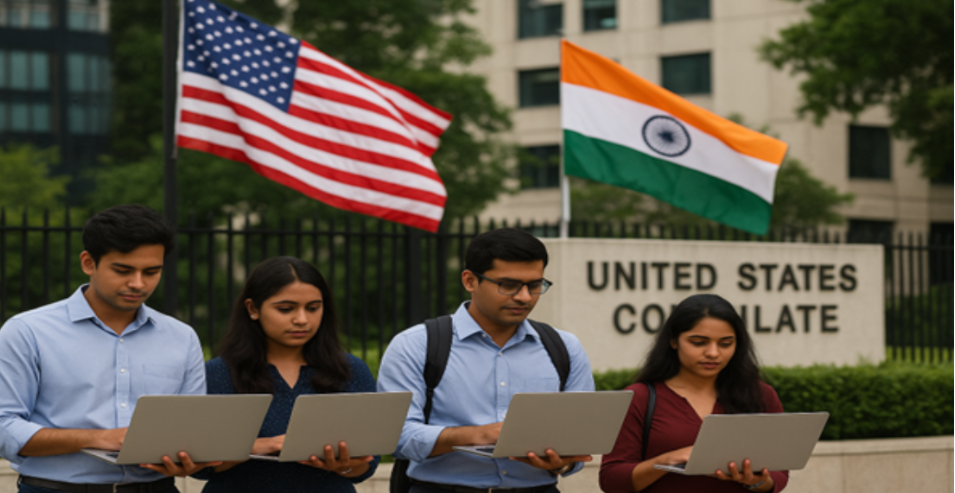
Earlier, moving abroad to pursue higher education used to be an elite ambition, which has now become a common dream among Indian students. More and more young people are looking outside India either for education or employment opportunities in every field, be it engineering, management, or social sciences. According to the Ministry of External Affairs, the number of Indian students studying abroad crossed 1.3 million in 2024. We can acknowledge this number as a sign of increased international mobility and aspirations among Indian youth, but it also highlights deeper issues related to inequality and access.
Hope for better career opportunities and better pay are the main reasons behind choosing abroad for education. IDP Education, in a survey, found that almost 77% of Indian students prioritise career prospects while choosing foreign education. Degrees earned in countries like the US, UK, Canada, and Australia are perceived to provide better job security and higher salaries than Indian degrees. This perception arises from the social realities in India, such as intense competition and limited seats. For instance, highly competitive entrance examinations like JEE and NEET have acceptance rates of less than 1–2%, leaving a large number of capable students without access to top-tier institutions. Even talented students believe that staying in India constrains their academic and professional growth, especially in research and specialised fields.
At the same time, this dream abroad is not equally accessible to everyone. Studying abroad is expensive, and one of the biggest barriers is the financial burden. According to the Transnational Education (TNE) Report 2024-25, one in three Indian students depends on loans to fund their overseas education. High tuition fees, housing costs, and additional expenses, such as health insurance, visa application fees, travel costs, security deposits for accommodation, and daily living expenses, place a significant financial burden on students and their families. Overseas education is becoming even more expensive, as the Indian rupee is losing its value in the global market.
Life abroad often differs significantly from the idealised images showcased in promotional brochures. For many Indian international students, everyday life involves managing multiple pressures, including financial stress, academic expectations, and the challenges of adjusting to a new cultural environment. These pressures are shaped even before migration through family expectations and financial commitments, which makes the experience more complex than simply “adjusting” to a new country. At the same time, the idea of studying abroad often hides the realities of loneliness, work pressure, and uncertainty.
Even though many students experience anxiety, stress, and emotional exhaustion, they often hesitate to seek help. This hesitation is not an individual choice, as cultural attitudes towards mental health and stigma shape how students respond to distress. Additionally, counselling services are not always accessible or culturally sensitive, which discourages students from using them. As a result, mental health struggles often remain unspoken and insufficiently addressed.
This issue is further complicated by the experiences of discrimination and exclusion. International students often face racism, visa uncertainty, and a sense of insecurity in their everyday lives. In the United Kingdom, media reports show, there are growing safety concerns for Indian students, including violent incidents that have caused fear among students and families. Experiences of online racial abuse are not limited to one context; for instance, reports from Similarly, media reports from Australia show that international students and the Indian diaspora have experienced online racial abuse. International students, including Indian students, have also reported everyday discrimination in classrooms and public spaces, which may impact their academic confidence and social life.
These issues are especially visible in Canada, where viral videos showing racist slurs against Indian origin people have drawn attention to rising hostility towards South Asian communities. Recent visa restrictions impacted students severely, with 80% of Indian study visa applications being rejected by Canada in 2025. Changes in visa rules and numbers across countries like the US, UK, and Australia have created uncertainty, leading to rejections and emotional stress for many students.
The outflow of Indian students in search of better career options also represents global inequality in education. The Global North or the First World countries benefit financially from tuition fees and skilled labour, while India invests in educating students who may not come back. Though some students do return, many choose to stay abroad due to better working conditions and research infrastructure. The idea of brain drain represents a loss of skilled human resources. When students choose to settle abroad after completing their education, India loses professionals such as doctors, engineers, researchers, and innovators who could have played an important role in the country’s development.
Ironically, India hosts very few international students despite the fact that it sends so many abroad. Less than 1% of global students choose India as their study destination, which highlights problems related to infrastructure, safety, and internationalisation.
The outmigration of Indian students also reflects inequalities within the country. Students from wealthier backgrounds and those who have better social networks can afford international education. In contrast, many talented students from less privileged backgrounds are unable to avail such opportunities due to high costs, limited information, and weak institutional support. This situation is exacerbated by the uneven performance of Indian higher education institutions, where limited research funding, inadequate infrastructure, and high competition restrict opportunities for academic growth.
As a result, students are expected to take personal responsibility for the risks created by systemic failures in public higher education. Instead of fixing problems such as poor funding and quality gaps across universities, students are encouraged to manage these gaps on their own by taking loans and moving abroad. This makes studying overseas look like a personal choice, even though it is often shaped by a lack of strong and reliable options within the country. Addressing these issues requires sustained investment in India’s own educational and research landscape, including stronger public universities, better funding for research, and more inclusive pathways that allow talent to thrive within the country.
Gorla Sravani
